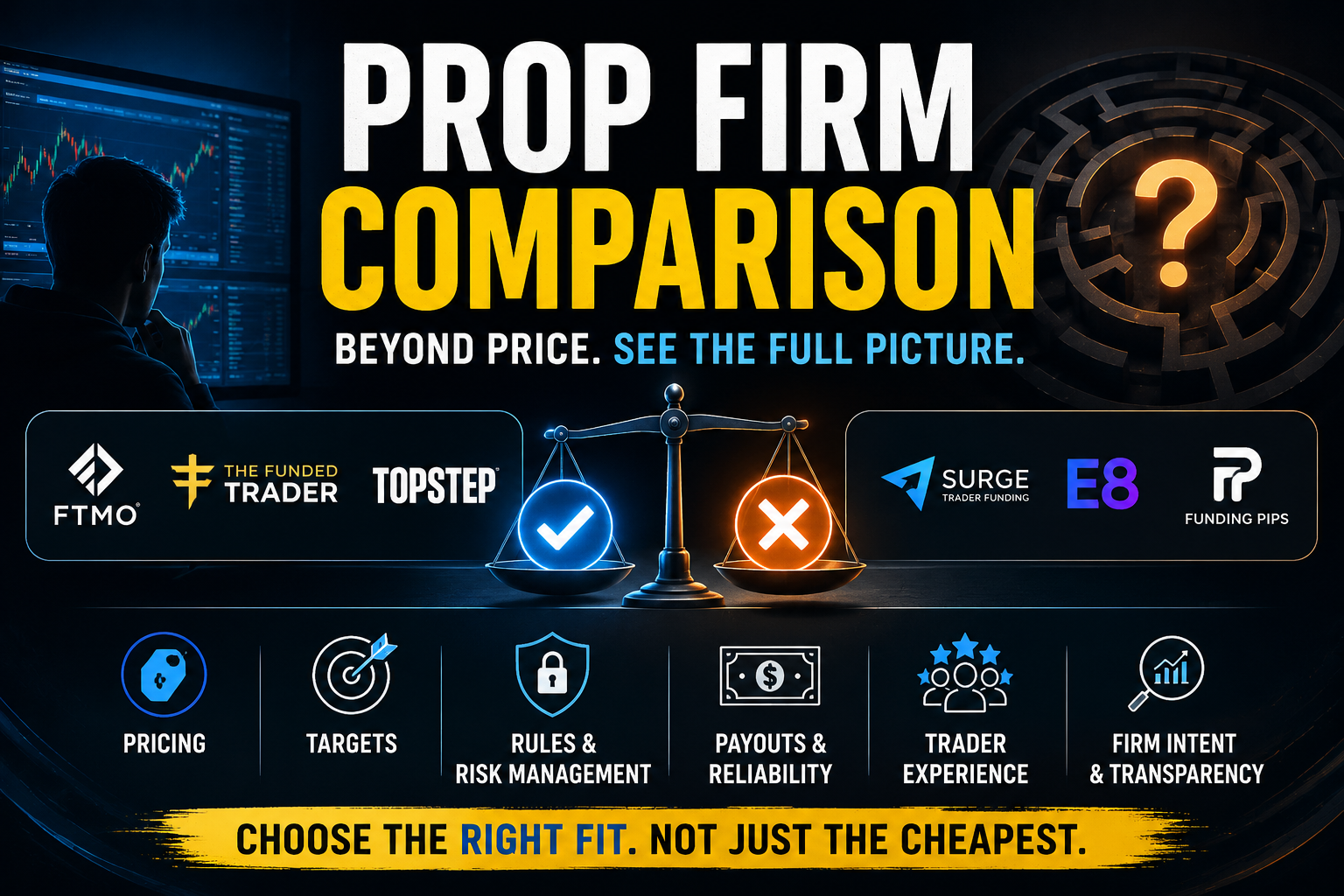
Most comparison pages for prop trading firms tend to focus on what looks easy to measure: price, profit targets, payout ratios, drawdown limits.
News flash: You are not shopping for Groceries! you participating in a complex industry, that has its attention on multiple edges.
Metrics are useful, but they only tell a small part of the story.
The comparison page is designed with a different intention
not just to stack firms side by side like a spreadsheet,
but to give a more complete view of how each firm actually operates as a business.
In fact, some firms selling literally the same product, liquidity provided by the same partners, even under a white-label, but can have completely different intentions on operations!
Some firms offer attractive pricing but enforce restrictive or complex trading rules that quietly reduce flexibility. Others may have slightly higher costs, but provide clearer conditions, smoother payout processes, and more trader-friendly structures. On paper, two firms can look almost identical, but in reality, one may support your trading style while the other constantly works against it.
And then there is an even more sensitive layer that most comparisons avoid entirely: intent.
Direct experience on one of the traps is documented here in the self inflicted failue testing FundingPips.
of course, there is no proof of malicious intent, in fact the whole issue was caused by the trader. there is no other blame to go around.
But the way the firm reacted to the problem and the solutions they provided made it very clear where the priorities are.
this is what SwingFish Prop-firm Comparison aims to point out.
Some firms operate in a way that can feel purely transactional or even predatory, the business model may appear to rely heavily on signup fees with little evidence of long-term commitment to payouts. Others may look similar at first glance, but are actually structured conservatively, with strict rules designed not to trap traders, but to protect the firm from going insolvent while still paying out consistently. The line between “overly strict risk management” and “bad-faith operation” can be surprisingly thin, and not always visible from the outside.
Reviews do not really help.
Unless you learn to read between the lines, as they tend to reflect individual experiences, timing, or isolated issues rather than the broader design of the firm. A five-star review doesn’t guarantee alignment with your strategy, just as a negative review doesn’t necessarily mean the firm is unsuitable for everyone.
The key point is this: prop firms are built with different intentions, risk models, and trader expectations in mind. And those intentions don’t always match yours.
That’s why the goal of a deeper comparison approach is not just to answer “Which is cheapest?” or “Which pays the most?”, but rather:
- How does this firm actually manage risk?
- What kind of trader is it optimized for?
- Do the rules support or restrict your strategy?
- What is the real experience of staying funded over time?
When you start looking at prop firms through that lens, the decision becomes less about picking a “best” option and more about finding the right fit between your trading behavior and their business model.
In short: numbers do noit tell the whole story, do not hunt for cheap, hunt for cost of staying in the game.