Market News

Forex Market News .. collected from serval sources, all in one place for you to review.
[most entries here, will be auto-removed after 90 days]

IC – Europe Fundamental Forecast | 04 September 2026

IC – Europe Fundamental Forecast | 04 September 2026

What happened in the Asia session?

Asian equities are benefiting from lower U.S. rate-hike expectations and the rebound in technology stocks, while the yen is the standout currency, gaining strongly on expectations of a more hawkish BOJ. South Korea’s exceptionally large current-account surplus is supporting the won, while the RBNZ’s latest 25 bp hike continues to underpin the NZD.

At the same time, oil remains strongly bullish above $96 Brent as U.S.–Iran tensions threaten Middle Eastern supply routes. The major catalyst still ahead is the U.S. jobs report, which could determine whether the dollar’s current weakness extends into the European and U.S. sessions.

What does it mean for the…
Read source

Friday 4th Sept 2026: Technical Outlook and Review

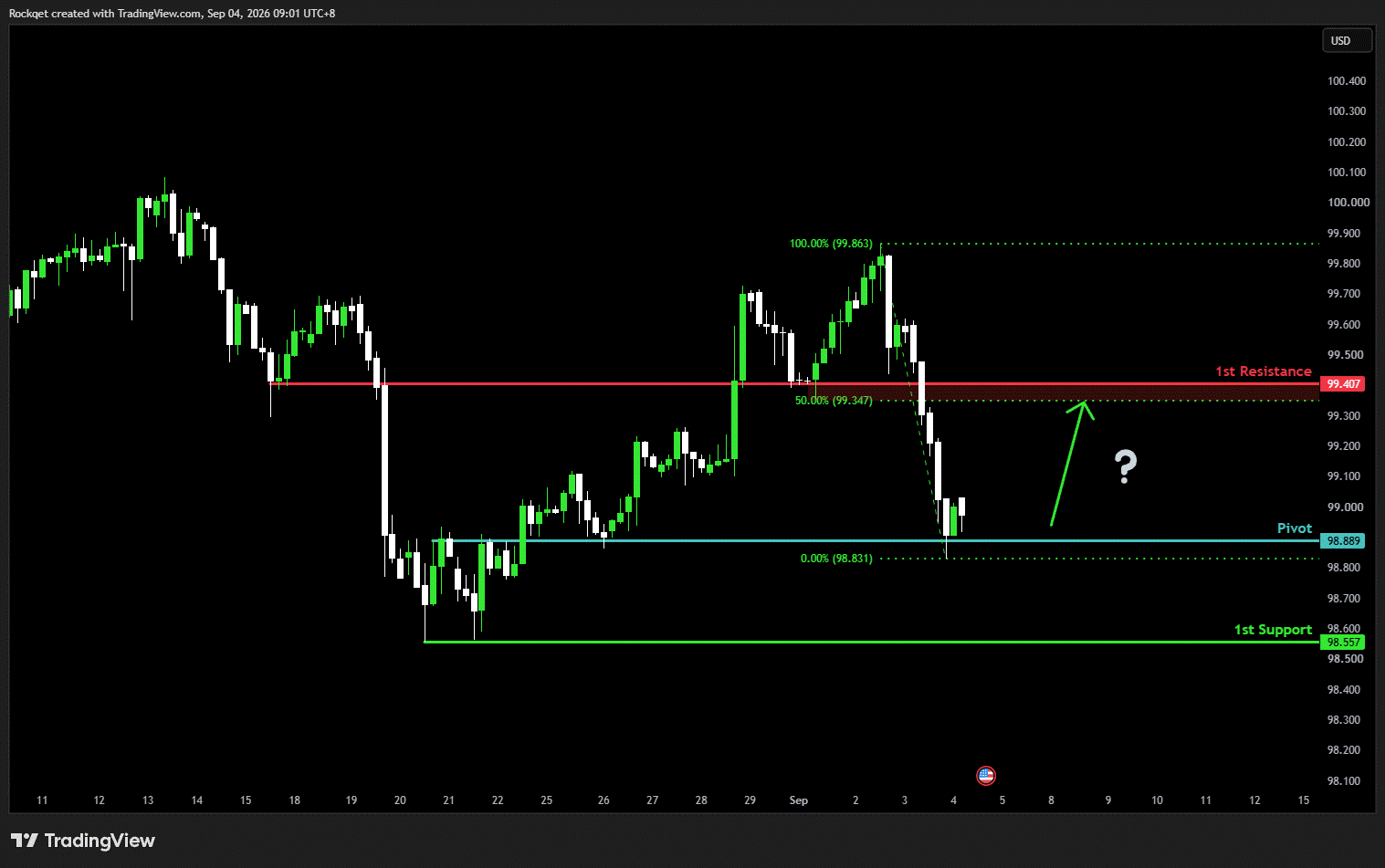
    DXY (U.S. Dollar Index):

Potential Direction: Bullish

Overall momentum of the chart: Bearish

The price could make a short-term pullback toward the pivot before rising again toward the 1st resistance

Pivot: 98.88

Supporting reasons: Identified as a pullback support, where renewed buying pressure could emerge to push the price higher.

1st support: 98.55

Supporting reasons: Identified as a swing low support, indicating a potential area where the price could again stabilize.

1st resistance: 99.40
Supporting reasons: Identified as a pullback resistance thatb aligns with the 50% Fibonacci retracement, indicating a potential area that could halt any further upward movement

EUR/USD:

Potential Direction:…

Read source

Friday 4th Sept 2026: U.S. Stock Futures Steady Ahead of Key August Jobs Report

Global Markets:

●         Asian Stock Markets : Nikkei up 1.03%, Shanghai Composite up 0.35% Hang Seng up 2.15% ASX down 0.15%

●        Commodities : Gold at $4,520.09 (-0.46%) Silver at $67.336 (-0.55%), Brent Oil at 95.97 (0.48%), WTI Oil at 91.98 (0.73%)

●        Rates : US 10-year yield at 4.766, UK 10-year yield at 5.1404, Germany 10-year yield at 3.3500

News & Data:

●        (USD)     Unemployment Claims  206K to 205%  expected

Markets Update:

U.S. stock futures were little changed Thursday evening as investors turned their attention to August’s closely watched payrolls report.

Dow Jones Industrial Average futures slipped 3 points, or 0.01%, while S&P 500 futures fell 0.03% and Nasdaq-100 futures declined…

Read source

General Market Analysis – 04/09/26

US Stocks Rally on Dovish Waller Comments – Nasdaq up 1.4%

US equities moved higher in trading yesterday following comments from Fed Governor Christopher Waller, who indicated that he would support leaving interest rates unchanged at the next meeting should incoming data confirm that inflation continues to cool. The comments helped ease concerns around the prospect of further monetary policy tightening, with the Dow rising 1.18% to 53,686, while the S&P 500 gained 1.06% to close at 7,747. The Nasdaq outperformed, advancing 1.40% to 26,584.

Treasury yields declined modestly as expectations around the Federal Reserve shifted. The US 2-year yield fell 3.2 basis points to 4.337%, while the 10-year yield declined 1.0 basis point to…

Read source

IC – Asia Fundamental Forecast | 04 September 2026

IC – Asia Fundamental Forecast | 04 September 2026

What happened in the U.S. session?

The overnight U.S. session was dominated by a softer labor-market signal from ADP, shifting Fed expectations, and persistent U.S.–Iran tensions. The weak 38K private payroll gain pressured the USD and Treasury yields while supporting gold, whereas elevated oil prices continued to create an inflationary risk that could prevent the Fed from becoming too dovish. U.S. equities nevertheless recovered as yields eased.

What does it mean for the Asia Session?

Friday’s Asian session could be dominated by yen strength, BoJ rate-hike expectations, oil/geopolitical risk, and positioning ahead of U.S. NFP. The yen is currently the standout currency after its sharp…

Read source

USD/JPY bounces near the major 155.00 support; pullback or the start of a rally into new highs?

FUNDAMENTAL OVERVIEW


USD:

The US dollar weakened across the board yesterday following surprisingly dovish comments from Fed Governor Waller. While he adopted a more hawkish stance at the beginning of the summer, yesterday he sounded less inclined to raise rates.

He said that he has finally been seeing signs of disinflation and added that he would not want to raise rates into a disinflationary environment. He said he would be willing to wait another month to “give disinflation a chance”. He also mentioned that the September rate decision will depend on the upcoming CPI report. If the data comes in hot, he would consider a rate hike.

Rate hike probabilities for …

Read source

FX option expiries for 4 September 10am New York cut

EUR/USD

  • 1.1700 (EUR 1.78 bn)
  • 1.1600 (EUR 3.13 bn)
  • 1.1500 (EUR 1.75 bn)

USD/JPY

  • 157.00 (US$ 2.19 bn)
  • 155.00 (US$ 2.94 mn)

GBP/USD

  • 1.3615 (GBP 439.22 mn)
  • 1.3500 (GBP 315.47 mn)
  • 1.3400 (GBP 304.19 mn)

USD/CAD

  • 1.4000 (USD 781.48 mn)
  • 1.3800 (USD 1.28 bn)

USD/CHF

  • 0.8150 (USD 548.73 mn)
  • 1.8050 (USD 313.98 mn)

AUD/USD

  • 0.7250 (AUD 737.92 mn)
  • 0.7200 (AUD 1.33 bn)
  • 0.7100 (AUD 1.19 bn)

NZD/USD

  • 0.5900 (NZD 221.69 mn)

    WHAT ARE OPTION EXPIRIES?

    The FX option expiration price levels refer to the strike prices where option contracts are set to expire. These levels include both calls and puts.

    When you see "EUR/USD at 1.1600 for €4 billion" it means there is a total of €4 billion worth of options (calls + puts combined) that have a strike price of 1.1600 and are expiring at that…

    Read source

    RBNZ signals December, not October, for its next rate hike

    This week's hike, the RBNZ's second straight, was the widely expected part of the decision. The more market-moving element was the tone of the accompanying statement, which investors read as pushing the timing of the next move out to December rather than October. Swaps pricing has shifted accordingly, with only a 31% chance now attached to an October hike versus effective certainty of one by December. That repricing reflects a central bank still committed to further tightening in principle, but signalling it wants more time to assess the impact of the hikes already delivered before moving again. For NZD, the near-term read is a currency without a fresh, immediate hawkish catalyst, since the committee's own framing argues against reading…

    Read source

    JPMorgan flags a $103 bn yen short position, unwind could push USD/JPY to 142

    Market impact: JPMorgan's warning centres on the risk that a break below 155 per dollar could trigger a self-reinforcing round of short covering, given the scale of bearish yen positioning the bank estimates remains outstanding. A full unwind of that scale could theoretically push dollar-yen into the 142 to 146 range, a materially stronger yen than current levels imply.

    At the same time, the bank is pushing back on what it sees as overly aggressive market expectations around both a GPIF asset reallocation and the pace of Bank of Japan rate hikes, arguing a sustained break much below its assumed 155 to 165 range is not yet a high-probability outcome. For yen traders, the setup is two-sided: positioning risk argues for caution on aggressive…

    Read source

    Diesel crunch, hot ISM data point to entrenched inflation risk: gold, equity risks

    Market impact: Two independent threads are now pointing at the same underlying risk from different angles. Platts data shows diesel, the fuel underpinning trucking, agriculture and freight, heading into peak seasonal demand with the thinnest supply buffers in years, a cost pressure with a direct mechanical channel into the price of moving and producing goods. Separately, KPMG US Chief Economist Diane Swonk, drawing on ISM manufacturing and services price indexes and the Fed's own Beige Book, argues that pipeline inflation pressures are resurging rather than fading, with tariff and transportation cost increases increasingly spilling from goods into services.

    Neither thread alone would necessarily move markets much further from where…

    Read source