
Articles

Trump says he would love to get rid of the extra 10% tariff on China
422983 October 31, 2025 23:00 Forexlive Latest News Market News
On Air Force One, Trump said he would love to get rid of the remaining 10% fentanyl tariff on China.
At this rate, China is going to have the lowest tariffs in the world.
Also:
- Says there are no strikes on Venezuela
I wonder if that leak to the Miami Herald was just to see what kind of alarms it raised or to flush something out in terms of intelligence.
- Says he will not restart negotiations with Canada
This article was written by Adam Button at investinglive.com.
US energy secretary: Goal is to bring Canada-US back together for trade talks
422982 October 31, 2025 21:39 Forexlive Latest News Market News
This is the first US cabinet official that’s talked about re-starting US-Canada trade talks. They fell apart last week after Trump had a tantrum about a Ronald Reagan ad.
The market almost entirely shrugged off the breakdown and Trump’s threat of fresh 10% tariffs on Canada, so this isn’t a surprise but there is some uncertainty on when trade talks might restart or conclude. There is a fairly narrow window now with US Thanksgiving and then Christmas coming.
This article was written by Adam Button at investinglive.com.
US stock futures are up 0.7%. Here are the pre-market winners, led by Amazon
422981 October 31, 2025 20:14 Forexlive Latest News Market News
I have been writing about the k-shaped economy this week but we’re increasingly in a k-shaped stock market. The S&P 500 hit a record this week but yesterday, 9% of stocks in the S&P 500 hit a 52-week low.
This is a market that’s being carried by some Mag7 names and the AI trade.
AbbVie (ABBV) — Fell 1.6% after another weak quarter in its aesthetics segment despite strength in new anti-inflammatory drugs.
Amazon (AMZN) — Up 13.5% on strong earnings ($1.95/sh vs. $1.57 est.) and $180.2B in revenue, beating expectations.
Apple (AAPL) — Added 2% after topping Q3 earnings and revenue forecasts and guiding for a strong holiday quarter.
Brighthouse Financial (BHF) — Soared 24% after FT said Aquarian Holdings is in talks to buy and take the insurer private.
Charter Communications (CHTR) — Fell 5% as EBITDA missed ($5.56B vs. $5.61B est.), offset by slightly better revenue.
Chevron (CVX) — Gained 1.5% as profits from the $53B Hess acquisition lifted oil output and cash flow.
Cboe Global Markets (CBOE) — Up 1% after beating Q3 estimates and announcing a business realignment and asset sales.
Dexcom (DXCM) — Dropped 12% after management warned 2026 revenue growth could trail Wall Street’s 15% forecast.
Exxon Mobil (XOM) — Shares down 0.8% despite beating Wall Street expectations for a sixth straight quarter, driven by new oil production in Guyana.
Intuitive Machines (LUNR) — Up 5% after an $8.2M Air Force contract extension for nuclear spacecraft power systems.
Netflix (NFLX) — Up 1.3% premarket; approved a 10-for-1 stock split and reportedly exploring a bid for Warner Bros. Discovery assets.
Newell Brands (NWL) — Sank 18% on weak earnings and guidance cut; now expects EPS of $0.56–$0.60 and revenue down 4.5–5%.
Nvidia (NVDA) — Flat; CEO Jensen Huang said he still hopes to sell Blackwell chips to China but has no near-term plans.
Ramaco Resources (METC) — Up 13% after signing a deal with the U.S. Energy Department to advance rare earths mining.
Strategy (MSTR) — Climbed 6% after revenue ($128.7M) topped estimates, helped by bitcoin exposure and software growth.
Twilio (TWLO) — Surged 11% as Q3 results beat estimates ($1.25/sh on $1.3B revenue vs. $1.08/sh est.).
Western Digital (WDC) — Gained 9% after earnings ($1.78/sh on $2.82B revenue) beat expectations.
This article was written by Adam Button at investinglive.com.
Trump set to authorize strikes inside Venezuela on military targets
422980 October 31, 2025 19:45 Forexlive Latest News Market News
The Miami Herald reports that the US is poised to strike military targets in Venezuela in escalation against Maduro regime.
This isn’t a hit on narcotics operations but on military installations. This is tantamount to an undeclared war, though the US is saying that drug trafficker use the installations.
Sources told the Herald that the targets — which could be struck by air in a matter of days or even hours — also aim to decapitate the cartel’s hierarchy. U.S. officials believe the cartel exports around 500 tons of cocaine yearly, split between Europe and the United States.
Oil is climbing on the headlines.
This article was written by Adam Button at investinglive.com.
Canada August GDP -0.3% vs 0.0% expected
422979 October 31, 2025 19:39 Forexlive Latest News Market News
- Prior was +0.2% (revised to +0.3%)
- Goods-producing industries declined 0.6% in August
- Services-producing industries edged down 0.1%
- Flight attendant strike behind a 1.7% decline in transportation and warehousing
- Wholesale trade sector declined 1.2% in August
- Mining, quarrying, and oil and gas extraction contracted 0.7% in August
- The utilities sector contracted 2.3% as worsening drought conditions hampered hydroelectric power generation
This article was written by Adam Button at investinglive.com.
investingLive European FX news wrap: Eurozone CPI ticks lower, core stays at 2.4%
422978 October 31, 2025 18:45 Forexlive Latest News Market News
- How have interest rate expectations changed after this week’s events?
- Italy October preliminary CPI (HICP) +1.3% vs +1.7% y/y expected
- Eurozone October preliminary CPI +2.1% vs +2.1% y/y expected
- ECB’s Simkus: In the medium-term, the projected indicators are aligned with the 2% target
- ECB survey: Long-term inflation expectations unchanged at 2%
- Nvidia CEO Huang: Hope the Blackwell can be sold in China
- ECB’s Kazaks: Risks to growth and inflation are more balanced
- ECB’s Muller: Current level of interest rates is appropriate
- France October preliminary CPI (HICP) +0.9% vs +1.0% y/y expected
- ECB’s Rehn: No major changes to outlook since September meeting
- Switzerland September retail sales Y/Y +1.5% vs +0.2% expected
- Germany September retail sales +0.2% vs +0.2% expected
- UK October Nationwide house prices Y/Y +2.4% vs +2.3% expected
- ECB’s Kocher: Some of the data since September is slightly better
- Japan’s labour union group UA Zensen decides to seek 6% wage hike in 2026 wage talks
- What are the main events for today?
- Canada’s PM Carney: Aiming to double our non-US exports over the course of next decade
- Japan September housing starts Y/Y -7.3% vs -7.9% expected
It’s been a pretty slow session with no major news releases. We got lots of Eurozone data but since the bar to change the ECB’s stance is high, the reaction in the euro has been muted.
We’ve also got lots of ECB speakers as they came out of the blackout period, but they continue to repeat the same stuff over and over again. The core message is that they are fine with the current policy setting and that they don’t expect much change in the medium-term. They keep citing uncertainty and risks on both sides of their forecasts, but the bar to cut or hike is high in absence of new shocks.
The most important economic report today was the Eurozone Flash CPI. The headline CPI ticked lower but matched forecasts, while the core measure beat estimates but matched the prior figure. The market understandably yawned on the data.
In the American session, we don’t have much on the agenda other than the Canadian GDP (which is very unlikely to change anything for the BoC at this point) and a few hawkish Fed speakers.
This article was written by Giuseppe Dellamotta at investinglive.com.
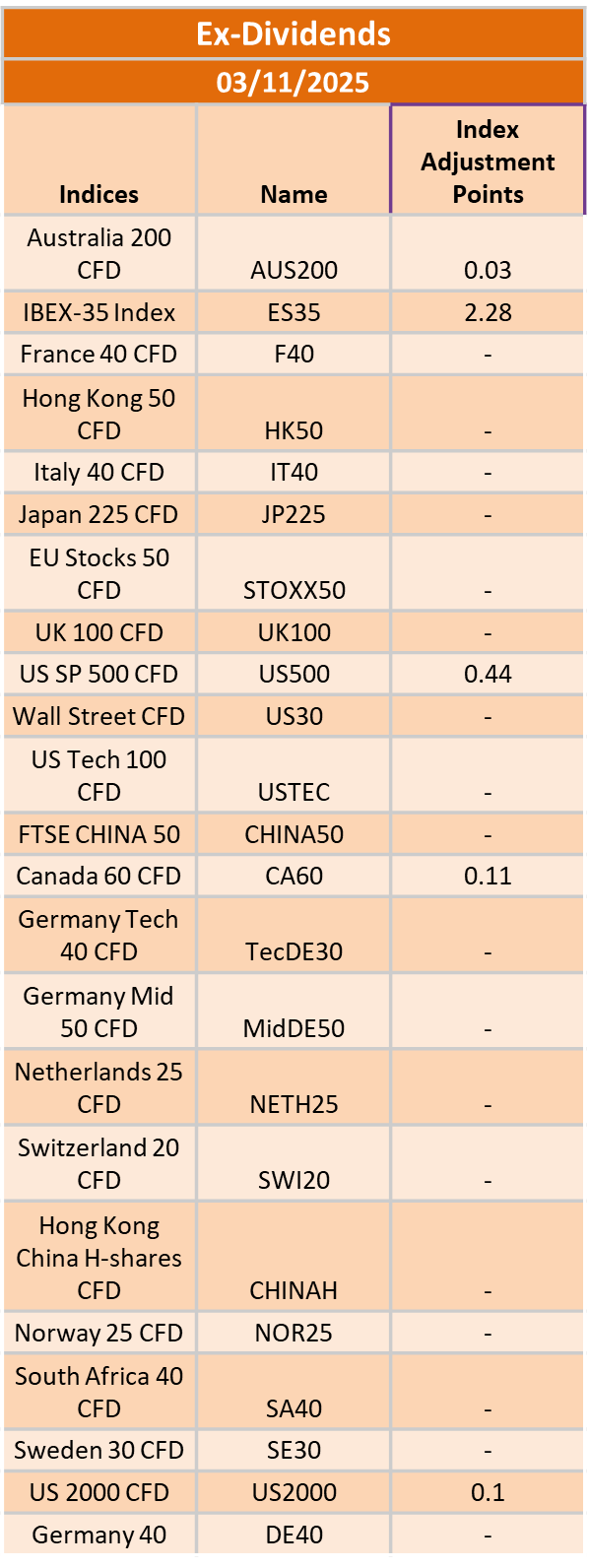
Ex-Dividend 3/11/2025
422976 October 31, 2025 17:39 ICMarkets Market News
The post Ex-Dividend 3/11/2025 first appeared on IC Markets | Official Blog.
Italy October preliminary CPI (HICP) +1.3% vs +1.7% y/y expected
422975 October 31, 2025 17:14 Forexlive Latest News Market News
- Prior +1.8%
- Core CPI Y/Y +2.0% vs +2.0% prior
- Full report here
Big downside surprise in the headline inflation data, but the core figure remained unchanged.
From the agency:
The slow down of the annual inflation rate was mainly due to the prices
of Regulated energy products (from +13.9% to -0.8%), of Unprocessed food
(from +4.8% to +1.9%) and, to a lesser extent, of Services related to
transport (from +2.4% to +2.0%). At the opposite, an upward contribution
to the inflation rate came from the prices of Services related to
recreation, including repair and personal care (from +3.1% to +3.3%).
This article was written by Giuseppe Dellamotta at investinglive.com.
Eurozone October preliminary CPI +2.1% vs +2.1% y/y expected
422974 October 31, 2025 17:14 Forexlive Latest News Market News
- Prior +2.2%
- Core CPI Y/Y +2.4% vs +2.3% expected
- Prior +2.4%
- Full report here
Slight downtick in the headline inflation but the core figure remained unchanged. This won’t change anything for the ECB, so the market reaction is understanbly muted.
From the agency:
Euro area annual inflation is expected to be 2.1% in October 2025, down from 2.2% in September according to a flash estimate from Eurostat, the statistical office of the European Union.
Looking at the main components of euro area inflation, services
is expected to have the highest annual rate in October (3.4%, compared
with 3.2% in September), followed by food, alcohol & tobacco (2.5%,
compared with 3.0% in September), non-energy industrial goods (0.6%,
compared with 0.8% in September) and energy (-1.0%, compared with -0.4%
in September).
This article was written by Giuseppe Dellamotta at investinglive.com.
General Market Analysis – 31/10/25
422973 October 31, 2025 16:39 ICMarkets Market News
US Stocks Hit on Mixed Earnings and Fed – Nasdaq Down 1.57%
US stocks took a hit in trading yesterday as mixed earnings reports from big tech players increased concerns about AI spending, and the ‘hawkish cut’ from the Fed continued to weigh. The Dow fell 0.23% to 47,522, but the pain was more pronounced in the S&P, which lost 0.99% to 6,822, and the Nasdaq, which fell 1.57% to 23,581. FX markets continued to digest yesterday’s Fed cut and holds from both the Bank of Japan and the European Central Bank, with the DXY up 0.33% to 99.53. US yields also gained ground again, with the 2-year up 1.1 basis points to 3.609% and the 10-year up 2.1 basis points to 4.097%. Oil markets were relatively steady as traders digested the trade truce between China and the US, with Brent down 0.29% to $64.73 and WTI up 0.15% to $60.57, while gold took off again, jumping 2.4% on the day to close at $4,024.54 an ounce.
USDJPY Back in Focus for Longer-Term FX Players
It has been a busy week again for FX traders, with a raft of major central bank updates hitting the markets for players to digest. Rate moves all went in line with expectations, with both the Bank of Canada and the Fed cutting, and the Bank of Japan and the ECB keeping rates on hold. However, the surprises came in forward guidance from two major banks that now have longer-term interest rate differential players looking for bigger moves in the weeks ahead. The FOMC surprised the market with a much less dovish update on the back of continued inflation issues and a lack of data moving forward (due to the government shutdown), while the Bank of Japan held rates and pulled back on expectations for a rate hike in December, with Governor Kazuo Ueda indicating that he could wait out the impact of new government policy on data for a few months. USDJPY has risen nearly 3% from its low on Wednesday and is now trading near key technical resistance. A break above recent highs just under 154.50 could see the move extend over the next few days and weeks to challenge the annual high of 158.87 set in January this year.
Another Volatile Day Expected for Traders
Traders are expecting to see more moves in the sessions ahead today as the market continues to digest a raft of updates from the past couple of days, as well as some fresh data points. Major central bank moves, trade updates between the US and China, and some big company earnings reports will all be competing in investors’ analysis today, and they should keep traders busy up to the New York 5 p.m. bell. The Asian session sees some key data out of both Japan and China today, with the initial focus on the Tokyo Core CPI data (exp. +2.6% y/y) before focus switches to China for the Manufacturing PMI (exp. 49.6) and Non-Manufacturing PMI (exp. 50.1) numbers. The London session will see the release of the EU’s Flash CPI (exp. +2.1%) and Core Flash CPI (exp. +2.3%) data, with moves expected in the euro around the release. The New York session will see Canadian GDP (exp. 0.0% m/m) data released early in the day before updates from Fed members Logan, Bostic, and Hammack later in the session.
The post General Market Analysis – 31/10/25 first appeared on IC Markets | Official Blog.
IC Markets – Europe Fundamental Forecast | 31 October 2025
422972 October 31, 2025 16:14 ICMarkets Market News
IC Markets – Europe Fundamental Forecast | 31 October 2025
What happened in the Asia session?
The Asia session on October 31, 2025, featured cautious market reactions as investors digested China’s mixed PMI data and steadied Tokyo CPI results, while global sentiment remained tentatively positive following the U.S.-China trade truce. Chinese equities and CNY were the most affected by the data, while Japanese and Australian assets enjoyed mild risk-on interest without major volatility.
What does it mean for the Europe & US sessions?
China’s weak PMI readings signal ongoing economic challenges in the world’s second-largest economy, while the surprise U.S.-China trade breakthrough has injected optimism into risk assets. Central banks have adopted divergent paths—the Fed signals caution on further cuts, the ECB maintains its extended pause, and the BoJ remains dovish despite inflation concerns. Exceptional earnings from tech giants Amazon and Apple have bolstered confidence in the U.S. corporate sector and consumer resilience.
The Dollar Index (DXY)
Key news events today
No major news event
What can we expect from DXY today?
The Dollar is under pressure due to a prolonged U.S. government shutdown, anticipated Federal Reserve rate cuts, and the delayed release of major U.S. economic data. However, some safe-haven flows and Fed commentary have led to temporary spurts of USD strength against select currencies, such as the Peso and ZAR, while the market waits for key inflation and employment figures.
Central Bank Notes:
- The Federal Open Market Committee (FOMC) voted, by majority, to lower the federal funds rate target range by 25 basis points to 3.75%–4.00% at its October 28–29, 2025, meeting, marking the second consecutive cut following the 25 basis points reduction in September.
- The Committee maintained its long-term objectives of maximum employment and 2% inflation, noting that the labor market continues to soften, with modest job creation and an unemployment rate edging higher. In comparison, inflation remains above target at around 3.0%.
- Policymakers highlighted ongoing downside risks to economic growth, tempered by signs of resilient economic activity. September’s consumer price index (CPI) came in slightly lower than expected at 3.0% year-over-year, easing inflation pressure but still warranting vigilance given tariff-driven price effects.
- Economic activity expanded modestly in the third quarter, with GDP growth estimates around 1.0% annualized; however, uncertainty remains elevated amid persistent global trade tensions and the U.S. government shutdown, which is impacting data availability.
- The updated Summary of Economic Projections reflects an anticipated unemployment rate averaging approximately 4.5% for 2025, with headline and core personal consumption expenditures (PCE) inflation projections holding near 3.0%, indicating a slow easing path ahead.
- The Committee emphasized its flexible, data-dependent approach and underscored that future policy adjustments will be guided by incoming labor market and inflation data. As in prior meetings, there was dissent, including one member advocating a more aggressive 50-basis-point cut.
- The FOMC announced the planned conclusion of its balance sheet reduction (quantitative tightening) program, intending to cease runoff in the near term to maintain market stability, with Treasury redemption caps held steady at $5 billion per month and agency mortgage-backed securities caps at $35 billion.
- The next meeting is scheduled for 9 to 10 December 2025.
Next 24 Hours Bias
Weak Bearish
Gold (XAU)
Key news events today
No major news event
What can we expect from Gold today?
Gold prices remain volatile today, Friday, with the market showing heightened sensitivity to central bank actions, macroeconomic signals, and ongoing geopolitical uncertainties. Prices continue to hover around the $4,000 level, reflecting a combination of recent bullish rallies fueled by Federal Reserve rate cuts, but technical signals warn of corrective downward pressure as investors react to mixed data and shifting sentiment.
Next 24 Hours Bias
Medium Bullish
The Euro (EUR)
Key news events today
Core CPI flash estimate y/y (10:00 am GMTT)
CPI flash estimate y/y (10:00 am GMT)
What can we expect from EUR today?
Eurozone inflation is stabilizing near ECB targets, allowing the central bank to hold rates steady.The market is digesting modest economic growth and new policy signals, with volatility persisting in major euro currency pairs.Major policy discussions include advancing plans for the digital euro and maintaining fiscal and structural reforms to reinforce competitiveness amid a slow global recovery.
Central Bank Notes:
- The Governing Council of the ECB kept the three key interest rates unchanged at its meeting on 30 October 2025. The main refinancing rate remains at 2.15%, the marginal lending facility at 2.40%, and the deposit facility at 2.00%. This decision reflects policymakers’ assessment that the current monetary stance remains consistent with medium-term price stability, while incoming data confirm a gradual return of inflation towards the target.
- Recent indicators point to stable price dynamics. Headline inflation remains near the 2% mark, with energy prices contained and food inflation easing slightly after earlier supply bottlenecks. Wage growth continues to moderate, contributing to the slowdown in domestic cost pressures. The ECB reiterated its commitment to a data-driven, meeting-by-meeting approach and emphasized flexibility in the face of uncertain global financial conditions.
- Eurosystem staff projections have not been materially altered since September. Headline inflation averages remain at 2.0% for 2025, 1.8% for 2026, and 2.0% for 2027. Recent softening in producer prices and subdued pipeline pressures suggest limited upside risks to inflation, though geopolitical tensions and potential commodity shocks continue to pose uncertainties to the outlook.
- Euro area GDP growth remains on track with earlier forecasts, projected at 1.1% for 2025, 1.1% for 2026, and 1.4% for 2027. Forward-looking indicators, including PMIs and industrial sentiment surveys, signal some stabilization in activity following weakness in the third quarter. Public investment and recovering export activity are expected to offset softer private sector demand in the near term.
- The labor market remains resilient, with unemployment rates at multi-decade lows and participation rates strong. Real income growth continues to support household spending, even as consumption growth normalizes from earlier highs. Financing conditions remain favorable, aided by stable banking sector liquidity and improved credit demand among small and medium-sized firms.
- Business sentiment remains mixed, reflecting lingering uncertainty over global trade policy and the path of US tariffs. However, easing supply chain costs and improved export competitiveness due to softer exchange rates are providing some relief to manufacturing and external-oriented sectors.
- The Governing Council reaffirmed that future decisions will depend on an integrated assessment of incoming data—covering inflation trends, financial conditions, and the state of policy transmission. The Council emphasized that no pre-set path for rates exists; keeping all options open should the economic outlook shift markedly.
- Balance sheet reduction continues smoothly, with holdings under the APP and PEPP declining as reinvestments have ceased. The ECB confirmed that the pace of portfolio runoff remains in line with its previously communicated normalization plan, supporting a gradual withdrawal of monetary accommodation in a predictable manner.
- The next meeting is on 17 to 18 December 2025
Next 24 Hours Bias
Weak Bearish
The Swiss Franc (CHF)
Key news events today
No major news event
What can we expect from CHF today?
The Swiss Franc (CHF) is seeing modest downward movement as of Friday, following recent strength throughout October. The most current data shows the CHF trading at 1.077 per euro as of October 30, which represents a very minor decrease of 0.03% from the previous day, but a 1.21% appreciation compared to one year ago. Against the US dollar, the USD/CHF pair has seen some volatility, trading at about 0.8022 with technical forecasts suggesting short-term bearish momentum but hints at a possible bullish correction before likely continuation of the downtrend.
Central Bank Notes:
- The SNB maintained its key policy rate at 0% during its meeting on 25 September 2025, pausing a sequence of six consecutive rate cuts as inflation stabilized and the Swiss franc remained firm.
- Recent data showed a modest rebound in inflation, with Swiss consumer prices rising 0.2% year-on-year in August after staying above zero for three consecutive months; this helped alleviate fears of deflation that were mounting earlier in the year.
- The conditional inflation forecast remains broadly unchanged from June: headline inflation is expected to average 0.2% in 2025, 0.5% in 2026, and 0.7% in 2027. The risk of a negative rate move has diminished for now, but the SNB retains flexibility should inflationary pressures weaken again.
- The global economic outlook has deteriorated further, weighed down by heightened trade tensions—especially with the U.S.—and ongoing uncertainty in key Swiss export markets.
- Swiss GDP growth moderated in Q2 after a strong Q1 boosted by front-loaded U.S. exports. The SNB expects growth to slow and remain subdued, with forecasted GDP expansion between 1% and 1.5% in both 2025 and 2026.
- Labor market sentiment in the Swiss industrial sector has softened on concerns over export competitiveness and potential adjustments to production, but the overall growth outlook stays broadly unchanged
- The SNB reiterated its readiness to respond as needed if deflation risks re-emerge, emphasizing its commitment to medium-term price stability and a robust, transparent communication policy, with the introduction of more detailed monetary policy minutes beginning in October.
- The next meeting is on 11 December 2025.
Next 24 Hours Bias
Weak Bullish
The Pound (GBP)
Key news events today
No major event
What can we expect from GBP today?
The British Pound remains under pressure as UK fiscal and monetary policy uncertainty, combined with a strong US Dollar, drives short-term downward momentum. While some technical forecasts suggest the possibility of a rebound if support levels hold, the overall environment currently favors further GBP/USD weakness. The GBP/USD currency pair is currently in a strong downtrend and trading within a descending channel, with immediate support identified near 1.3100 and resistance around 1.3245.
Central Bank Notes:
- The Bank of England’s Monetary Policy Committee (MPC) voted on 18 September 2025 by a majority (expected split likely 7–2 or 6–3) to hold the Bank Rate steady at 4.00%, following the rate cut in August. Most members cited persistent inflation and mixed indicators on growth and employment, while a minority favored further easing due to the cooling labor market and subdued GDP growth.
- The Committee decided to decrease the pace of quantitative tightening, planning to reduce the stock of UK government bond purchases by £67.5 billion over the next 12 months, instead of the prior £100 billion pace, with the gilt balance now standing at nearly £558 billion. This reflects increased volatility in bond markets and a shift to a more gradual approach.
- Headline inflation rose unexpectedly to 3.8% in July and is projected at 4% for September, above the Bank’s 2% target. Price pressures are driven by regulated energy costs and ongoing food price increases. While previous disinflation has been substantial, core inflation remains elevated and sticky.
- The MPC expects headline inflation to remain above target through Q4, with a resumption of the downward trend projected for early 2026 as energy and regulated price pressures abate. The Committee remains watchful for signs of persistent inflation despite previous policy tightening.
- UK GDP growth is stagnant, with business and consumer activity subdued. Recent labor market data show rising unemployment rates (now at 4.7%) and stabilizing wage growth (holding near 5%), indicating slack but continued wage price pressure. The Committee remains cautious amid lackluster demand and soft survey sentiment.
- Pay growth and employment indicators have moderated further, alongside confirmation from business surveys that pay settlements are slowing. The Committee expects wage growth to decelerate significantly through Q4 and the rest of 2025.
- Global uncertainty persists due to volatile energy prices, supply chain disruptions linked to Middle East conflicts, and renewed trade tensions. The MPC remains vigilant in tracking transmission of external cost/wage shocks to UK inflation.
- Risks to inflation are considered two-sided. While subdued domestic growth and softening labor activity suggest scope for easing, persistent inflation requires caution. The MPC anticipates a slow, gradual reduction path in rates, continuing its data-dependent approach with careful adjustment as warranted by economic developments.
- The Committee’s bias remains toward maintaining a restrictive monetary policy stance until firmer evidence emerges that inflation will return sustainably to the 2% target. All future decisions will remain highly data dependent, with a strong emphasis on evolving demand, inflation expectations, costs, and labor market conditions.
- The next meeting is on 6 November 2025.
Next 24 Hours Bias
Medium Bearish
The Canadian Dollar (CAD)
Key news events today
GDP m/m (12:30 pm GMT)
What can we expect from CAD today?
The Canadian Dollar remains weak as October ends, pressured by stalled GDP growth, risk-averse global sentiment, and lackluster domestic data. The focus today is on Canada’s monthly GDP report, expected at 12:30 pm GMT, which could further influence CAD direction. The USD/CAD pair climbed to 1.3988, with the US Dollar gaining 0.32% against the CAD yesterday, snapping a three-session losing streak. The CAD continues to trade near its 12-week low, and the greenback remains up 3% from its June lows.
Central Bank Notes:
- The Council noted that U.S. tariff tensions have eased slightly following early progress in bilateral discussions, though the external trade environment remains fragile. Businesses continue to hold back on long-term investment, with the Bank highlighting that sustained clarity on U.S. trade policy is needed to restore confidence.
- The Bank acknowledged that uncertainty persists despite the softer U.S. tone, as incoming data show limited improvement in export orders. The manufacturing sector has stabilized but remains below pre-2024 output levels, reflecting weak global demand and cautious corporate spending.
- Canada’s economy showed tentative signs of recovery in early Q4, with GDP estimated to expand by 0.3% in October after two quarters of contraction. Mining and energy activity strengthened modestly, aided by steady crude demand, while goods exports posted a fractional gain.
- Service sector growth remained uneven, supported mainly by tourism-related and technology services. However, retail spending and household consumption were subdued, constrained by slower job creation and lingering consumer caution. The Bank judged overall momentum as fragile but improving marginally.
- Housing activity showed modest reacceleration in major urban markets as mortgage rates stabilized near record lows. Nonetheless, affordability pressures and stricter lending standards continue to cap overall resale volumes, leading to only a gradual recovery in the housing sector.
- Headline CPI inflation rose to 2.1% in October, reaching the Bank’s target for the first time in six months. The increase was driven by higher energy prices and a modest uptick in food and shelter costs. Core inflation measures remained stable, suggesting underlying price pressures are contained.
- The Governing Council reiterated its data-dependent stance, indicating that the current policy rate remains appropriate amid tentative growth and balanced inflation risks. Officials noted that while additional stimulus is not ruled out, the emphasis has shifted toward monitoring the sustainability of the recovery rather than immediate rate adjustments.
- The next meeting is on 17 to 18 December 2025.
Next 24 Hours Bias
Weak Bearish
Oil
Key news events today
No major new event
What can we expect from Oil today?
The oil market today is pausing its decline amid tight inventories and headline-driven rebounds, but it remains fundamentally weighed down by oversupply and macroeconomic caution. Analysts expect continued volatility, with oversupply predicted to persist into late 2025 and 2026. While sanctions and unexpected drawdowns support prices temporarily, structural headwinds such as weak demand growth and surplus production, especially from OPEC+ and the U.S., are likely to keep oil prices under downward pressure in the coming months.
Next 24 Hours Bias
Medium Bearish
The post IC Markets – Europe Fundamental Forecast | 31 October 2025 first appeared on IC Markets | Official Blog.
IC Markets – Asia Fundamental Forecast | 31 October 2025
422971 October 31, 2025 16:14 ICMarkets Market News
IC Markets – Asia Fundamental Forecast | 31 October 2025
What happened in the U.S. session?
The U.S. trading session was characterized by significant volatility driven by three major catalysts: the Federal Reserve’s hawkish rate cut, mixed Big Tech earnings revealing surging AI costs, and a tentative U.S.-China trade truce. Chair Powell’s cautious stance on future rate cuts triggered a repricing across asset classes, with Treasury yields surging, the dollar strengthening, and rate-cut probabilities declining sharply. The U.S.-China trade agreement provided some relief but lacked concrete details, leaving markets cautious about its durability.
What does it mean for the Asia Session?
Friday presents a data-heavy session for Asian traders with several market-moving releases. The combination of China’s PMI data showing continued manufacturing weakness, Japan’s inflation readings supporting potential BOJ rate hikes, and Australia’s credit growth metrics will provide crucial insights into regional economic health. The backdrop of evolving U.S.-China trade relations, recent central bank decisions, and global inflation trends creates a complex trading environment requiring careful attention to both domestic fundamentals and international policy developments.
The Dollar Index (DXY)
Key news events today
No major news event
What can we expect from DXY today?
The dollar’s strength heading into the weekend reflects several competing forces. Fed Chair Powell’s hawkish messaging and emphasis on policy uncertainty provided immediate support, as markets recalibrated expectations for further rate cuts. The US-China trade agreement removed a significant geopolitical risk, though questions remain about implementation and longer-term sustainability. The government shutdown continues to damage economic activity, with the CBO estimating permanent GDP losses. Labor market weakness is evident in alternative data despite the absence of official reports.
Central Bank Notes:
- The Federal Open Market Committee (FOMC) voted, by majority, to lower the federal funds rate target range by 25 basis points to 3.75%–4.00% at its October 28–29, 2025, meeting, marking the second consecutive cut following the 25 basis points reduction in September.
- The Committee maintained its long-term objectives of maximum employment and 2% inflation, noting that the labor market continues to soften, with modest job creation and an unemployment rate edging higher. In comparison, inflation remains above target at around 3.0%.
- Policymakers highlighted ongoing downside risks to economic growth, tempered by signs of resilient economic activity. September’s consumer price index (CPI) came in slightly lower than expected at 3.0% year-over-year, easing inflation pressure but still warranting vigilance given tariff-driven price effects.
- Economic activity expanded modestly in the third quarter, with GDP growth estimates around 1.0% annualized; however, uncertainty remains elevated amid persistent global trade tensions and the U.S. government shutdown, which is impacting data availability.
- The updated Summary of Economic Projections reflects an anticipated unemployment rate averaging approximately 4.5% for 2025, with headline and core personal consumption expenditures (PCE) inflation projections holding near 3.0%, indicating a slow easing path ahead.
- The Committee emphasized its flexible, data-dependent approach and underscored that future policy adjustments will be guided by incoming labor market and inflation data. As in prior meetings, there was dissent, including one member advocating a more aggressive 50-basis-point cut.
- The FOMC announced the planned conclusion of its balance sheet reduction (quantitative tightening) program, intending to cease runoff in the near term to maintain market stability, with Treasury redemption caps held steady at $5 billion per month and agency mortgage-backed securities caps at $35 billion.
- The next meeting is scheduled for 9 to 10 December 2025.
Next 24 Hours Bias
Medium Bearish
Gold (XAU)
Key news events today
No major news event
What can we expect from Gold today?
Gold markets reflect a complex interplay of supportive fundamentals and near-term technical pressures. Record-breaking Q3 demand totaling 1,313 tonnes, sustained central bank buying approaching 900 tonnes annually, and surging ETF inflows demonstrate robust institutional and retail appetite for the precious metal. However, the Federal Reserve’s cautious rate-cut outlook, progress in U.S.-China trade negotiations, and profit-taking following the 50% year-to-date rally have triggered a healthy correction from October’s record highs.
Next 24 Hours Bias
Medium Bullish
The Australian Dollar (AUD)
Key news events today
No major news event
What can we expect from AUD today?
Trump-Xi meeting at APEC summit yielded agreements to reduce tariffs from 57% to 47%, suspend rare earth restrictions, and resume agricultural purchases—reducing regional uncertainty and supporting commodity currencies. As expected, the Fed delivered a 25bp cut to 3.75-4.00%, but Powell’s hawkish tone, warning against assuming a December cut, sent the dollar higher and pressured AUD/USD despite strong Australian inflation
Central Bank Notes:
- The RBA held its cash rate steady at 3.60% at its October meeting on 29–30 September 2025, marking a second consecutive pause after August’s 25 basis point cut. The move affirms the Bank’s data-dependent approach as inflation trends within the target range.
- Inflation indicators remained stable through September, with headline CPI likely anchoring near 2.2%—comfortably within the 2–3% band. Insurance and housing costs remain sticky but are increasingly offset by moderation in discretionary goods.
- Trimmed mean inflation is estimated at around 2.8%, signaling underlying pressures remain contained. The Board continues to flag food and energy price volatility as short-term risks, though the broader disinflation narrative holds.
- Global conditions remain a source of uncertainty. U.S. policy expectations and uneven growth in China continue to weigh on commodities, even as trade disruptions have eased marginally since mid-year.
- Domestic growth shows resilience in the housing and services sectors, though manufacturing remains subdued. Household incomes have stabilized, but consumption remains only modest, capped by high borrowing costs.
- The labor market maintains relative tightness, though job growth has slowed notably since the first half of the year. Underutilization has ticked higher, but overall employment conditions remain supportive.
- Wage growth is plateauing, reflecting softer labor demand. Weak productivity continues to keep unit labor costs elevated, underscoring a medium-term concern highlighted repeatedly by the RBA.
- Household consumption prospects remain fragile. The combination of high rents and weak discretionary appetite suggests risks of a consumer-led slowdown in Q4 if confidence fails to rebound.
- The Board reiterated that subdued household spending poses risks to business sentiment and may dampen investment and job creation in the coming quarters.
- Monetary policy remains mildly restrictive. The RBA balanced confidence in inflation progress with caution around global and domestic demand risks, keeping further adjustments conditional on incoming data.
- The Bank reaffirmed its dual commitment to price stability and full employment, noting its readiness to act should conditions shift markedly.
- The next meeting is on 5 to 6 November 2025.
Next 24 Hours Bias
Medium Bullish
The Kiwi Dollar (NZD)
Key news events today
No major news event
What can we expect from NZD today?
The New Zealand Dollar faces a challenging environment as it closes out October 2025. While improving business confidence and the US-China trade truce provide some positive underpinnings, several factors are weighing on the currency. Negative Pressures: Renewed US Dollar strength following hawkish Fed commentary, declining dairy prices in consecutive GDT auctions, weak consumer confidence, and expectations of further RBNZ rate cuts are limiting NZD upside.
Central Bank Notes:
- The Monetary Policy Committee (MPC) agreed to cut the Official Cash Rate (OCR) by 50 basis points to 2.50% on 8 October 2025, exceeding market expectations for a smaller 25-basis-point reduction and signaling a stronger commitment to reviving growth.
- The decision was reached by consensus, marking a shift from previous split votes, and reflected policymakers’ shared view that sustained economic weakness and persistent disinflationary pressures required a more front-loaded policy response.
- Annual consumer price inflation stood at 2.7% in the June quarter and is seen nearing 3% for the September quarter—above the 2% midpoint but within the 1–3% target range. Despite high near-term readings, the MPC projects inflation will return toward 2% by the first half of 2026 as spare capacity and moderating tradables curb price momentum.
- Policymakers acknowledged that domestic demand remains weak, with household spending, business investment, and construction activity under pressure. While still elevated, services inflation is expected to ease gradually as wage growth slows and unemployment edges higher.
- Financial conditions have eased with expectations as wholesale and retail borrowing rates adjust to lower policy settings. Bank lending data indicate a modest uptick in mortgage approvals, though broader credit demand remains subdued.
- GDP growth stalled in the middle of 2025, with high-frequency indicators showing continued weakness into the third quarter. A combination of elevated costs for essentials and falling savings continues to restrain household consumption, while global trade frictions weigh on business sentiment.
- The MPC noted that global uncertainty—particularly from US trade regulation changes and soft Chinese demand—continues to pose downside risks to export sectors, though these are partly offset by a weaker New Zealand dollar improving competitiveness.
- Subject to data confirming a sustained soft patch in activity and moderating inflation pressures, the MPC signaled further scope to reduce the OCR toward 2.25% at its next meeting on 26 November 2025, consistent with current market and Westpac forecasts.
- The next meeting is on 26 November 2025.
Next 24 Hours Bias
Weak Bullish
The Japanese Yen (JPY)
Key news events today
No major news events
What can we expect from JPY today?
The Japanese yen faces significant headwinds entering the weekend, pressured by the BOJ’s dovish hold on rates, widening monetary policy divergence with the Fed, improved U.S.-China trade relations that reduce safe-haven demand, and Governor Ueda’s cautious stance on near-term tightening. While inflation remains above the BOJ’s 2% target and manufacturing data shows continued contraction, policymakers appear willing to maintain accommodative policy until wage growth solidifies and global economic uncertainties—particularly around U.S. trade policies—diminish.
Central Bank Notes:
- The Policy Board of the Bank of Japan met on 30–31 October and by a clear majority vote, decided to maintain its key monetary policy approach for the upcoming period.
- The BOJ will continue to encourage the uncollateralized overnight call rate to remain at around 0.5%, in line with the prior stance.
- The gradual quarterly reduction in monthly outright purchases of Japanese Government Bonds (JGBs) remains intact, with amounts unchanged from the previous schedule. Purchases are set to decrease by about ¥400 billion per quarter through March 2026, shifting to about ¥200 billion per quarter from April to June 2026, and targeting a ¥2 trillion purchase level for Q1 2027. The bank reaffirmed its intention to maintain flexibility, with readiness to respond if market conditions warrant an adjustment.
- Japan’s economy continues to show moderate recovery, primarily led by solid capital expenditures, although export growth and corporate activity remain restrained by external demand uncertainty and the ongoing effects of U.S. trade policies.
- Annual headline inflation (excluding fresh food) accelerated to 2.9% year-on-year in September, marking the first uptick in four months and staying above the BOJ’s 2% target. Broad-based inflation persists, with food and energy cost pressures, but wage growth continues to support household consumption. Input cost pressures from the earlier surge in imports eased slightly.
- Short-term inflation momentum could moderate as food-price hikes ease, though rent, healthcare, and service-sector price increases tied to labor shortages provide support. Firms and households maintain a gradual upward drift in inflation expectations.
- For the near term, BOJ projects growth below trend as external demand stays subdued and corporate investment plans remain cautious. Still, accommodative financial conditions and steady gains in real labor income will underpin domestic consumption.
- Over the medium term, as overseas economies recover and trade conditions normalize, Japan’s growth potential should improve. Persistent labor market tightness, higher wage settlements, and rising medium- to long-term inflation expectations are expected to keep core inflation on a gradual upward trajectory, converging toward the 2% price stability target later in the forecast horizon.
- The next meeting is scheduled for 18 to 19 December 2025.
Next 24 Hours Bias
weak Bearish
Oil
Key news events today
No major news event
What can we expect from Oil today?
Crude oil prices remain under pressure, driven by record global output, continued oversupply, and tepid demand. Brent hovers under $65/barrel, and WTI sits below $60/barrel, with additional supply from OPEC+ anticipated next month. Despite a sharp draw in US inventories and some bright spots (e.g., jet fuel demand, BP’s Brazil discovery), the outlook is bearish as fears of a large global surplus persist. Key upcoming events—the Trump–Xi summit and OPEC+ supply review—could trigger short-term volatility, but unless demand picks up, the multi-month downtrend in oil prices is likely to continue into November.
Next 24 Hours Bias
Medium Bearish
The post IC Markets – Asia Fundamental Forecast | 31 October 2025 first appeared on IC Markets | Official Blog.