
Articles
China new bank lending stumbles once again in 2025
January 15, 2026 14:15 Forexlive Latest News Market News
That’s a bummer and it underscores that credit appetite remains lacking in China as lawmakers and policymakers struggle to bolster domestic demand conditions for the most part. After posting its first annual decline in new lending in 13 years in 2024, China is now seeing back-to-back drop in new bank lending after another fall in 2025.
In 2024, new yuan loans amounted to a total ¥18.09 trillion. Meanwhile, that figure drops to ¥16.27 trillion in 2025. Ouch.
For some context, the drop above comes after new yuan loans hit a record high of approximately ¥22.8 trillion in 2023 – which marked an increase from the ¥21.31 trillion back in 2022.
There are a myriad of factors driving the trend above with the property market slump of course being the main culprit, impacting consumer confidence and spending. Meanwhile, overcapacity concerns are also an issue now and not to mention the lack of effective stimulus from Beijing in general i.e. not being targeted enough.
This article was written by Justin Low at investinglive.com.
UK November monthly GDP +0.3% vs +0.1% m/m expected
January 15, 2026 14:14 Forexlive Latest News Market News
- Prior -0.1%
- GDP +1.4% vs +1.1% y/y expected
- Prior +1.1%
The more detailed breakdown as per the following:
- Services +0.3% vs +0.1% m/m expected
- Prior -0.3%
- Industrial output +1.1% vs +0.1% m/m expected
- Prior +1.1%; revised to +1.3%
- Manufacturing output +2.1% vs +0.5% m/m expected
- Prior +0.5%; revised to +0.4%
- Construction output -1.3% vs 0.0% m/m expected
- Prior -0.6%; revised to -1.2%
Amid a better-than-expected showing in services output, that helped to see UK economic activity outperform in November. That being said, there is a bit of a lag to the release here and it isn’t one that will shake up the BOE outlook. As things stand, inflation data remains the most important economic data that the central bank is watching.
But hey, at least the economy is not really stumbling all too much towards the end of last year – for now. The rising cost of living crisis is still a major concern that will need addressing in the bigger picture for this year.
This article was written by Justin Low at investinglive.com.
Silver pulls back from the highs, major currencies steady ahead of European trading
January 15, 2026 13:00 Forexlive Latest News Market News
When moves tend to go parabolic, the profit-taking naturally can be swift and sharp. And that’s what we’re seeing with silver after hitting highs of over $93 overnight before a quick plunge in Asia. There is some light buying seen closer to $86.50 for now but key near-term support will only come closer to $85, with the 100-hour moving average also seen at $85.12 currently.
The precious metal is down nearly 6% currently to $87.73 on the day with price movements still extremely volatile. That being said, it hardly looks like much of a dent even when looking at the near-term chart:
Amid the drop in silver, gold is also seeing some selling as it cools back under the $4,600 mark. The move here is much more measured and composed though with the precious metal down 0.8% to $4,583 currently.
And also in the commodities space, oil is in the spotlight amid geopolitical headlines involving Iran. After hitting its 200-day moving average yesterday, WTI crude oil is facing a pushback with Trump also toning things down as price falls another 2% today to $59.78 currently. The high yesterday touched $61.50.
Looking at other markets, equities remain more tentative after tech shares sold off yesterday while major currencies are not really showing all too much appetite for now. The dollar remains steadier at the balance, with light movements yesterday and that is carrying over to today as well.
USD/JPY remains the key focus in the major currencies space after Tokyo officials stepped in with some verbal intervention yesterday. And in case you missed it, this oddly specific remark (9 January drop in the currency being “not in line with fundamentals”) by Japan finance minister Katayama is what stands out in my view.
The pair is little changed at 158.50 currently, backing off after hitting a high of 159.45 yesterday. But for the time being, a probe towards 160.00 remains a possibility although intervention risks have definitely risen.
This article was written by Justin Low at investinglive.com.
Ex-Dividend 15/01/2026
January 15, 2026 12:39 ICMarkets Market News
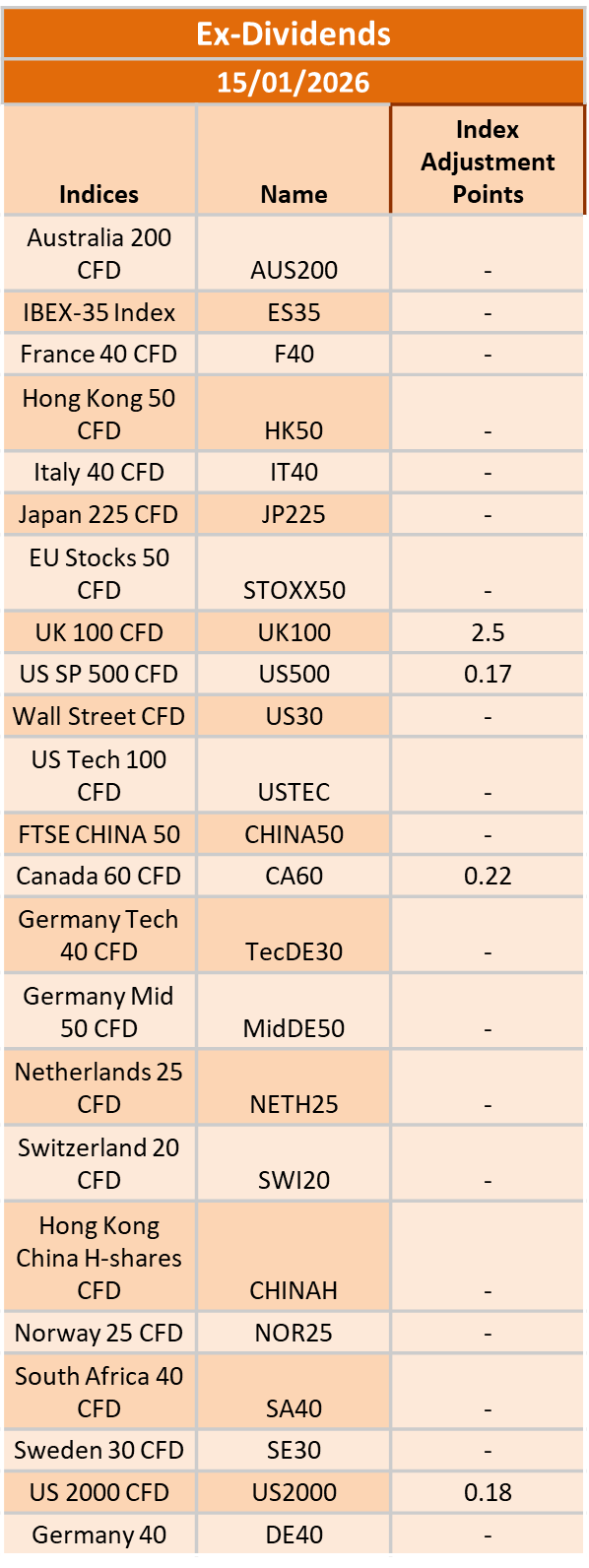
The post Ex-Dividend 15/01/2026 first appeared on IC Markets | Official Blog.
investingLive Asia-Pacific FX news wrap: Silver slammed lower
January 15, 2026 11:39 Forexlive Latest News Market News
- BOJ seen holding rates through March, lifting them to 1% or higher by September, maybeJuly
- BOJ Ueda reiterates sustained wage–price cycle, signals further rate hikes if f’casts hold
- China hails Carney visit as symbolic as Canada seeks to steady relations
- U.S. Senate delays crypto market structure bill amid industry and political rifts
- BOK’s Rhee warns weak won can lift inflation, signals U.S. trade and FX update
- Yen steadies on intervention warnings, but Takaichi trade keeps pressure intact
- Bank of Korea holds at 2.5% and drops easing-bias language as growth risks tilt up
- PBOC sets USD/ CNY reference rate for today at 7.0064 (vs. estimate at 6.9678)
- Oil slips: US calls UN security council meet.
- UK housing outlook brightens. Also, Britain climbs global FDI rankings.
- ICYMI – Venezuelan oil exports to China set to slump as U.S. blockade bites
- Japan December 2025 PPI +0.1% m/m (expected +0.1%, prior +0.3%)
- Japan firms warn China tensions threaten economy as BOJ rate hike wins support
- Trump touts Venezuela oil talks after crude slid earlier on his Iran remarks
- Bessent warns on excessive FX volatility in talks with Japan, urges sound communication
- Trump imposes 25% tariff on select advanced AI chips, signals broader semiconductor levies
- Trump invokes national security powers to cut U.S. reliance on imported critical minerals
- investingLive Americas market news wrap: US retail sales modestly beat. Eyes on Iran
At a glance:
-
Trump orders critical-minerals talks, invokes Section 232; silver drops sharply from record highs.
-
White House imposes 25% tariff on select advanced AI chips, citing national security.
-
U.S.–Japan talks flag excessive FX volatility; USD/JPY steadies near 158.60.
-
Geopolitics in focus as U.S. seeks UN briefing on Iran, Trump signals preference for swift action.
-
Asia policy mix steady: Japan PPI elevated, BOK holds rates, PBoC sets strongest CNY fix since 2023.
President Donald Trump ordered the Commerce Department and the Office of the United States Trade Representative to negotiate agreements aimed at cutting U.S. reliance on imported processed critical minerals, citing national security risks. He invoked Section 232 authority to monitor and adjust imports if necessary, following a meeting earlier this week led by Scott Bessent, where critical mineral supply security was flagged as a priority. The orders were cited by traders as a contributor to the sharp fall in silver prices from record highs.
Trump also signed a proclamation targeting semiconductor imports on national security grounds, imposing a 25% tariff on a narrow set of advanced computing chips. The White House specifically named products such as Nvidia’s H200 and Advanced Micro Devices’s MI325X.
Separately, the U.S. Treasury said Bessent raised concerns about “excessive” exchange-rate volatility in a meeting with his Japanese counterpart, stressing that large, disorderly currency moves are undesirable and can undermine economic and financial stability. Treasury added that Bessent emphasised the need for sound monetary policy formulation and clear communication to anchor expectations and limit destabilising FX swings.
The USD/JPY response was muted following Wednesday’s sharp decline, with the pair trading slightly firmer on the session to near 158.60 highs. In Japan, December wholesale inflation, the Producer Price Index, also known as the Corporate Goods Price Index, came in line with expectations but remained elevated at 2.4% y/y.
Geopolitics also remained in focus after NBC News reported Trump wants any renewed U.S. military action against Iran to be “swift and decisive,” though advisers warned a rapid collapse of the Iranian government cannot be guaranteed. Separately, the United Nations Security Council is set to meet Thursday for a U.S.-requested briefing on the situation in Iran.
In Asia, the Bank of Korea held its benchmark rate steady as expected, while monitoring won weakness and risks tied to property-market imbalances. China’s People’s Bank of China set the daily yuan fixing at its strongest level (for CNY) since May 18, 2023.
In corporate news, Toyota Motor sweetened its bid for Toyota Industries by 15% to ¥18,800 per share, sending Toyota Industries shares to a record high.
Asia-Pac
stocks:
- Japan
(Nikkei 225) -0.88% - Hong
Kong (Hang Seng) -0.55% - Shanghai
Composite -0.6% - Australia
(S&P/ASX 200) +0.43%
This article was written by Eamonn Sheridan at investinglive.com.
China hails Carney visit as symbolic as Canada seeks to steady relations
January 15, 2026 11:00 Forexlive Latest News Market News
Summary:
-
China calls Carney’s visit pivotal and symbolic
-
Beijing signals willingness to rebuild trust with Canada
-
Ottawa strikes cooperative, forward-looking tone
-
Visit hints at tentative reset after strained relations
-
Near-term symbolism outweighs immediate policy substance
China and Canada struck a conciliatory tone on bilateral relations as China’s foreign minister described Prime Minister Mark Carney’s visit as having “pivotal” and “symbolic” significance, signalling a potential reset after several years of strained ties.
In comments released by China’s foreign ministry, Wang Yi said Beijing was willing to enhance mutual trust, improve communication and eliminate interference in order to deepen cooperation with Canada. The remarks underscore China’s interest in stabilising relations with a G7 economy at a time when geopolitical fragmentation and trade realignment are reshaping global supply chains.
Canada’s foreign minister Mélanie Joly echoed the forward-looking tone, saying both sides would continue to make progress together over the short and long term for the benefit of people in both countries. While no concrete policy measures were announced, the language marked a notable shift toward engagement after years dominated by disputes over security, trade barriers and diplomatic tensions.
Carney’s visit comes as Ottawa reassesses its international economic strategy amid slower global growth and rising competition for investment and export markets. For Beijing, the outreach fits with a broader push to reduce diplomatic isolation and shore up ties with advanced economies even as relations with the United States remain tense.
The symbolism of the visit may matter more than immediate outcomes. Improved dialogue could eventually smooth cooperation in areas such as climate policy, agriculture, education and selective trade, while also lowering the risk of further escalation in politically sensitive sectors. Markets will be watching for any follow-through, particularly given Canada’s exposure to global commodities and China’s role as a major end-market, but for now the visit appears aimed at rebuilding trust rather than delivering near-term deals.
This article was written by Eamonn Sheridan at investinglive.com.
UK housing outlook brightens. Also, Britain climbs global FDI rankings.
January 15, 2026 08:00 Forexlive Latest News Market News
Summary:
-
RICS sees sales expectations turn significantly more positive
-
House price balance steady, but activity remains weak
-
Rate-cut expectations and fiscal clarity lift housing sentiment
-
UK climbs to third in global FDI rankings, McKinsey says
-
AI and clean energy dominate inflows, manufacturing lags
Britain’s housing market showed tentative signs of stabilisation in December, with surveyors turning more upbeat on the outlook for sales and prices despite ongoing weakness in current activity, according to the Royal Institution of Chartered Surveyors (RICS).
The RICS survey showed the headline house price balance holding at -14 in December, unchanged from November, though the prior month’s reading was revised slightly higher. While buyer enquiries remained in negative territory for a sixth consecutive month, near-term and 12-month sales expectations improved sharply. Expectations for sales volumes over the next three months rose to their highest level since October 2024, while optimism for the year ahead climbed to the strongest level since late 2024.
RICS attributed the improved sentiment to easing uncertainty around UK fiscal policy following Chancellor Rachel Reeves’ November budget, as well as growing confidence that borrowing costs will fall further as the Bank of England moves closer to interest-rate cuts. New vendor instructions stabilised after months of decline, though surveyors cautioned that low appraisal activity suggests any meaningful increase in housing stock will take time. Conditions in the rental market softened, with tenant demand easing and new landlord instructions remaining deeply negative.
In other news, Britain has climbed global rankings as a destination for foreign direct investment, helped by strong inflows linked to artificial intelligence and clean energy, according to consultancy McKinsey & Company.
McKinsey said the UK ranked as the world’s third-largest destination for newly announced FDI projects between 2022 and 2025, behind the United States and India, with annual inflation-adjusted inflows averaging around $85 billion. However, the firm warned that investment remains heavily concentrated in large AI and clean-energy projects, with comparatively little flowing into advanced manufacturing such as EV batteries and semiconductors, leaving Britain at risk of missing out on broader industrial investment.
This article was written by Eamonn Sheridan at investinglive.com.
Japan December 2025 PPI +0.1% m/m (expected +0.1%, prior +0.3%)
January 15, 2026 07:00 Forexlive Latest News Market News
more to come
—
Earlier, repeating ICYMI:
Japan’s Producer Price Index (PPI), officially known as the Corporate Goods Price Index (CGPI), measures changes over time in the prices that domestic producers receive for the goods they sell. The index is compiled and published by the Bank of Japan, and is designed to capture price movements earlier in the supply chain than consumer-facing inflation gauges.
Unlike the Consumer Price Index (CPI), which tracks the prices households pay for a basket of goods and services, the CGPI focuses solely on prices charged by companies. As such, it provides insight into cost pressures facing producers rather than consumers. Movements in the index can therefore act as an early signal of inflationary forces building within the economy, particularly if firms attempt to pass rising costs on to end users.
The CGPI is constructed using a broad basket of domestically produced goods that reflects the structure of Japan’s industrial economy. This includes raw materials such as metals and chemicals, semi-finished goods, and a range of finished products. Each category is assigned a weight based on its relative importance to overall economic activity, allowing the index to capture shifts across different stages of production.
However, the CGPI has several limitations worth noting. It does not adjust for quality improvements over time, which means price increases may sometimes overstate underlying inflation. In addition, the index only covers domestically produced goods and excludes imported items, limiting its usefulness in assessing external price shocks such as exchange-rate moves or global commodity swings.
From a market perspective, the CGPI is closely watched for its implications for both consumer inflation and currency dynamics. A firmer-than-expected reading could support the view that pipeline inflation remains alive, potentially lending the yen short-term support. However, given the broader backdrop of expected fiscal stimulus, political uncertainty, and speculation over an early election, any yen strength following the release may struggle to persist once the initial reaction fades.
This article was written by Eamonn Sheridan at investinglive.com.
Japan firms warn China tensions threaten economy as BOJ rate hike wins support
January 15, 2026 06:14 Forexlive Latest News Market News
Summary:
-
Two-thirds of Japan firms expect economy to suffer from frayed China ties
-
Nearly half report or anticipate direct business impact
-
Rare-earth supply risk flagged as critical vulnerability
-
43% may reassess China-linked business if tensions persist
-
Majority back BOJ’s latest rate hike, citing yen risks
More than two-thirds of Japanese companies expect the domestic economy to suffer from deteriorating ties with China, according to a Reuters corporate survey, highlighting rising concern over geopolitics, supply chains and export exposure. Nearly half of firms said they are already seeing, or expect to see, a direct business impact from tensions with Japan’s largest trading partner.
Relations have worsened since Prime Minister Sanae Takaichi warned in November that a Chinese attack on Taiwan could pose an existential threat to Japan, a comment Beijing condemned as “provocative.” Since then, China has advised its citizens against travelling to Japan and imposed restrictions on exports of goods with potential military applications, stoking fears of tighter controls on rare-earth shipments critical to Japan’s automotive and electronics sectors.
The survey found that 9% of firms reported their business had already been affected, while a further 35% anticipate some impact. Tourism-linked sectors appear to be among the earliest casualties, with one transport operator citing falling Chinese visitor numbers weighing on hotel utilisation and room revenues. Manufacturers, meanwhile, flagged strategic vulnerability to China’s control over rare-earth processing, with one electronics executive describing policy shifts as a “matter of life and death.”
China still accounts for roughly 60% of Japan’s rare-earth imports despite years of diversification efforts. Reflecting this exposure, 43% of respondents said prolonged deterioration in bilateral relations would likely force a reassessment of China-related business, including sales, procurement and production footprints.
On monetary policy, sentiment was notably more settled. Almost two-thirds of firms judged the Bank of Japan’s latest interest-rate hike appropriate, backing the move to lift the policy rate to a 30-year high of 0.75%. Respondents broadly agreed that failing to normalise policy risks further yen depreciation, which many view as a longer-term drag on the economy. Looking ahead, opinions on the timing of the next hike were split, though most see further tightening as inevitable if growth and inflation track forecasts outlined by Kazuo Ueda.
This article was written by Eamonn Sheridan at investinglive.com.
investingLive Americas market news wrap: US retail sales modestly beat. Eyes on Iran
January 15, 2026 04:14 Forexlive Latest News Market News
- US November retail sales +0.6% vs +0.4% expected
- US November PPI final demand Y/Y +3.0% vs +2.7% expected
- US Supreme Court doesn’t issue decision on tariffs
- Beige Book: Overall activity increased at slight-to-modest pace in most districts
- Fedspeak recap: Odds of a January or March rate cut dwindle
- EIA weekly US crude oil inventories +3391K vs -1702K expected
- US Oct business inventories +0.3% vs +0.2% expected
- US existing home sales 4.35m vs 4.21m expected
- US Q3 current account -226B vs -238B expected
- Trump appears to have decided on a military strike against Iran – Reuters
Markets:
- Gold and silver hit fresh records
- WTI crude oil down $1.15 to $60.06
- US 10-year yields down 2.7 bps to 4.14%
- Bitcoin up 3.8%
- S&P 500 down 0.7%
- JPY leads, USD lags
Eyes were on the Supreme Court today but we didn’t get a tariff decision. There was some trepidation in markets ahead of time with stocks sliding but when no ruling was issued, there was a sizeable pop in stocks. Unfortunately, it slowly faded over the day and the S&P 500 was down more than 1% at the lows, with megacap tech names and financials dragging.
Gold and silver were in the spotlight once again with Iran and potential US attacks as a possible catalyst. Beyond that, gold did a nice turnabout to highs after some selling midway through yesterday’s US session. That was halted in Asia and there was a steady march higher today and a 7% further pop in silver to $93 for the first time ever.
The FX market was less action-packed as the US dollar mostly slid. The headline on the retail sales report was a touch better but revisions were lower and the core components a drag. Auto sales flattered the headline while better measures of consumer comfort were less-enthusiastic.
Comments from financials on the US consumer and lending outlook were positive but that didn’t stop a round of profit taking, including a 4% fall in Bank of America shares. The earnings continue on Thursday.
Oil was hit with a huge build in US gasoline inventories for the second week but with turmoil potentially coming in Iran, the crowded short in crude were getting out of the way in a squeeze as high as $62.36. However later in the day, Trump said that executions had stopped and there was a report that a high-profile one had been postponed. That was seen as de-escalatio and oil quickly fell more than $2/barrel. That’s the spot to watch in the day ahead.
This article was written by Adam Button at investinglive.com.
Economic and event calendar in Asia Thursday, January 15, 2026 – Japan wholesale inflation
January 15, 2026 04:14 Forexlive Latest News Market News
Japan’s Producer Price Index (PPI), officially known as the Corporate Goods Price Index (CGPI), measures changes over time in the prices that domestic producers receive for the goods they sell. The index is compiled and published by the Bank of Japan, and is designed to capture price movements earlier in the supply chain than consumer-facing inflation gauges.
Unlike the Consumer Price Index (CPI), which tracks the prices households pay for a basket of goods and services, the CGPI focuses solely on prices charged by companies. As such, it provides insight into cost pressures facing producers rather than consumers. Movements in the index can therefore act as an early signal of inflationary forces building within the economy, particularly if firms attempt to pass rising costs on to end users.
The CGPI is constructed using a broad basket of domestically produced goods that reflects the structure of Japan’s industrial economy. This includes raw materials such as metals and chemicals, semi-finished goods, and a range of finished products. Each category is assigned a weight based on its relative importance to overall economic activity, allowing the index to capture shifts across different stages of production.
However, the CGPI has several limitations worth noting. It does not adjust for quality improvements over time, which means price increases may sometimes overstate underlying inflation. In addition, the index only covers domestically produced goods and excludes imported items, limiting its usefulness in assessing external price shocks such as exchange-rate moves or global commodity swings.
From a market perspective, the CGPI is closely watched for its implications for both consumer inflation and currency dynamics. A firmer-than-expected reading could support the view that pipeline inflation remains alive, potentially lending the yen short-term support. However, given the broader backdrop of expected fiscal stimulus, political uncertainty, and speculation over an early election, any yen strength following the release may struggle to persist once the initial reaction fades.
- This snapshot from the investingLive economic data calendar.
- The times in the left-most column are GMT, subtract 5 hours for the US Eastern time
- The numbers in the right-most column are the ‘prior’ (previous month/quarter as the case may be) result. The number in the column next to that, where there is a number, is the consensus median expected.
This article was written by Eamonn Sheridan at investinglive.com.
EIA weekly US crude oil inventories +3391K vs -1702K expected
January 14, 2026 22:39 Forexlive Latest News Market News
- Prior was -3832K
- Gasoline +8977K vs +3565K exp
- Distillates -29K vs +512K exp
That’s a mammoth gasoline build on top of another huge one last week. It will be tough to keep oil prices up with that much product in the system.
Private oil inventories released late yesterday:
- Crude +5270K
- Gasoline +8230K
- Distillates +4340K
Given the private survey, the big build in the official numbers isn’t a huge surprise .That said, earlier oil gains have faded with WTI at $61.69 from a high of $62.10.
This article was written by Adam Button at investinglive.com.